Evliya Çelebi’s Seyahâtnâme; the Great Account of the Ottoman Empire at the Height of its Power
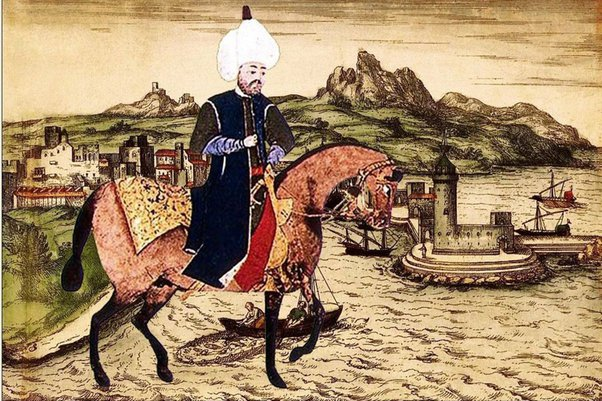
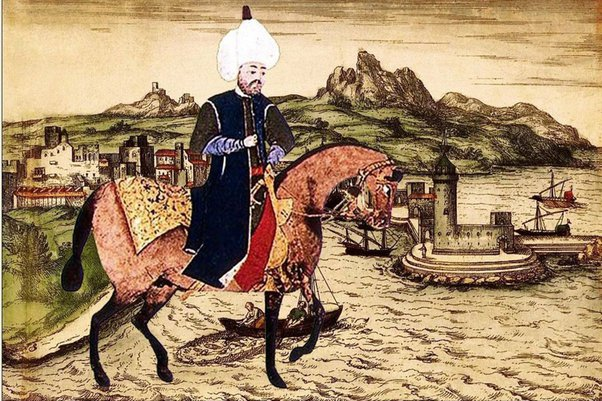
A painting of Evliya Çelebi. Credit: David Szabo
Four hundred years ago, in a dream, Evliya Çelebi confused the words for “intercession” and “travel,” and instead of getting peace of mind from the Prophet’s blessing, he inadvertently sentenced himself to a lifetime of global travel (Dankoff 2010, p.3). This dream starts the Seyahatname, a ten volume chronicle of the travels of Evliya Çelebi to every part of the Ottoman Empire. It is a vividly and fantastically told experience, to the point of being almost too fantastical for historians, with alleged raids into Europe as part of a Tartar army that went as far as Amsterdam, which did not happen. While his travel was at points an unpleasant experience for him–particularly when he was shipwrecked in the Black Sea– the value for both scholars and casual readers today of his Seyahâtnâme is significant. The amount of detail that Evliya Çelebi provides in his accounts makes it uniquely valuable as a historical source, and the vivid and deeply human narratives he weaves, full of characters defined by flaws and failures, make it uniquely valuable as a casual source, available to anyone with a dozen or so hours to spare. I would contend it is the most valuable primary source concerning the Ottoman Empire in the 17th century, and one that is as valuable to scholars historically, as it is to casual readers, in its exploration of the human condition.
Evliya Çelebi

Evliya Çelebi statue. Credit: globetrotter19
Evliya Çelebi was born in 1611 in Istanbul, during the reign of Sultan Ahmed I (Dankoff 2010). His father was a goldsmith who served the Ottoman court, and through his mother, he was related to Melek Ahmed Pasha, who would be one of his foremost supporters and patrons over the course of his life. Through a mix of his father’s position at court and connections with relatives, Evliya Çelebi’s family was wealthy, making him a member of the Ottoman elite from the beginning of his life, and it is a position he would hold on to and improve upon over the course of his life. Aside from his privileged position, he himself was brilliant, and precocious enough as a child to be able to recite the Quran from memory, which ended up getting the attention of Sultan Murad IV, with whom he would end up considering a close friend. Despite being a member of the upper echelon of Ottoman society, Evliya Çelebi never wanted to serve as an official of any kind, and instead chose to spend his life traveling to every corner of the Ottoman empire. He was able to do this because he was constantly supported by various patrons within the Ottoman court, who he would regale with stories of the adventures that they had funded whenever he would return from one of his journeys.
The Seyahâtnâme

A depiction of the procession of the thieve’s guild, based on Evliya Çelebi’s account. Credit: Roguish
All we know of Evliya Çelebi’s life outside of his name appearing on the manifest of an Ottoman embassy to Vienna in 1665 (Elfenbein 2012), comes from the Seyahâtnâme, and as such it is impossible to discuss one without discussing the other. The Seyahâtnâme covers forty years of Evliya Çelebi’s travels, and is divided into ten volumes (Dankoff 2010). Each of the volumes concerns a specific city or area he went to, and as such they are labeled by their location name. In volume one, Evliya Çelebi the city of Istanbul, although he introduces the volume with his famous passage on meeting Muhammad in a dream, which was mentioned in passing in the introduction to this paper. Volume two takes him around the Black Sea, in a journey which involves “anti-infidel” raids and a traumatic shipwreck, followed by a description of his miraculous survival of that disaster, and concludes with a journey to Persia, although this time he accompanies an official Ottoman embassy there, something he would do a few more times over the course of the Seyahâtnâme to other polities. Volumes three through five take him east to Syria, Persia, Baghdad, and Armenia. Volume six was written in the aftermath of the death of his patron, Melek Ahmed Pasha, but manages to get support to join a campaign against the Austrians, and from volume six to eight he is on campaign in Hungary, Austria, and Crete. In volume nine he finally joins a hajj to Mecca, also taking time to visit Jerusalem and Medina, and in the final volume ten, he finds a new patron in the governor of Egypt, who sponsors a journey or two up and down the Nile, after which he concluded the Seyahâtnâme and is assumed to have died around 1683.
Evliya Çelebi, the Historian

Cover of the 1895 edition of the Seyahâtnâme. Credit: Atatürk Kitaplığı
Throughout these volumes, in most chapters Evliya Çelebi would start by describing the history and administrative organization of the city or area in question, to be followed by copious descriptions of the buildings and the culture. Part of the inherent value in his work is the degree to which he both described these in intense detail, but didn’t necessarily adhere to a perfect standard of interpretive accuracy, instead choosing to relay to the reader what he himself thought of the things taking place in the city. An example of all of this can be found in his description of the Süleymaniye Mosque. Evliya starts by describing the making of the mosque itself, and how Suleiman apparently brought together thousands of master architects, builders, and laborers, along with three thousand galley slaves, who were responsible for digging the foundation. Over the course of the chapter, he discusses specific architectural features, art, and the context in which they were made, and it is the last category in particular that provides information that is so vital to historians of this period in Ottoman history. This is because while we as historians have access to the edifice itself, and potentially even some contemporary sources describing its construction, it is only from Evliya Çelebi that we can get access to information such as how “Admiral Ant” transported four red porphyry columns from Egypt, and presented them to “Suleiman Khan” with a poem, all of which pleased Suleiman enough to grant him a governorship (Dankoff 2010, p.9). Even in a passage this limited, one can find notable information that might not be found anywhere else, and certainly not all in the same place and put in context with each other as they are in the Seyahâtnâme. For example, on a close reading of the text, one can find out how monumental architecture like these columns were transported from Egypt, where these rafts were unloaded (Unkapani) and where the columns were brought to be presented to the Sultan (Vefa Square). A historian might even be able to make something out of the poem that Admiral Ant delivers to Suleiman, either in the fact that it describes the Egyptian columns as “a locust’s leg” or in that it was delivered at all (Dankoff 2010, p.9).
Evliya Celebi, the Storyteller

The procession of the thieve’s guild, as described by Evliya Çelebi. Here used to represent the shipwrecked crew from Evliya Çelebi’s voyage in the Black Sea. Credit: Rogue Archives
I want to conclude this post with a brief account of Evliya Çelebi’s disastrous voyage in the Black Sea. I do this because the reason it was worth Ozbek Bey saving a copy of it in his private library for a century (Dankoff 2011), and the reason it is still widely read today, is because it is fun to read. This passage of the Seyahâtnâme starts off as if it’s going to be a normal sea voyage, with favorable winds, and his usual hyper-specific attention to details such as the head-count of the slaves and captives abroad– 350 souls–and who they were owned by: Ucali Sefer. However, the situation starts to deteriorate quickly, with whirlpools besetting the ship on either side and black storm clouds leveling gale-force winds at them. It is easy to forget that you’re reading an Ottoman travelogue when old sailors start shouting “Avast my hearties! Lower the topmast!” but old Dede Dayi is there saying it nonetheless. At this point everyone onboard is in a state of panic, and it is in moments like this that Evliya Çelebi is at his best: in describing the emotions of his characters. While he does take some liberties with how he describes his own actions–I do not believe that the Evliya Çelebi represented in the Seyahâtnâme is the kind of person to leap aboard a raft of “infidels” trying to abandon ship and defeat them in hand-to-hand combat– throughout the passage, the characters are indelibly human, and highly flawed. There are moments of heroism, such as the sailors struggling to stabilize the ship even as their compatriots are jumping overboard, moments of panic and the mistakes incumbent to it, such as the sailors who chop down a mast and kill eleven crewmates, and moments of cowardice, such as when Evliya lets a Russian child drown rather than risking the extra weight on a plank he’s clinging to. The Seyahâtnâme, like all great works of literature, can be read critically or for leisure, and in both cases convey meaning. In these narrative passages, even if you don’t care to devote the time to analyzing the concrete details Evliya provides, you can still find passages like this, in which Evliya Çelebi explores what it means to be human, and relays lessons that are easily applicable in the present day. At the same time, if you do care to devote the time, the exhaustive detail Evliya Çelebi provides can be used to explore in equally exhaustive detail the Ottoman Empire in the 17th century. Few other historical sources can serve both purposes as successfully as the Seyahâtnâme does, and as such, its value as a primary source is unique, and unrivaled with respect to the 17th century Ottoman Empire.
References
Cakir, Okan. “Jews from Konstantiniyye to Islambol: Istanbul jewry in the 17th century according to the accounts of Evliya and Eremya Çelebi.” Master’s thesis, The Ohio State University, 2005.
Elfenbein, Madeleine, Gratien, Chris and Arabacı, Elçin.”Evliya Çelebi: Early Modern Travel and Ottoman Sensibilities,” Ottoman History Podcast, No. 63 (August 7, 2012) http://www.ottomanhistorypodcast.com/2012/08/evliya-celebi-early-modern-travel-and.html.
Evliya Çelebi and Dankoff, Robert. 2011. An Ottoman Traveller : Selections from the Book of Travels of Evliya Çelebi. London: Eland.
Dankoff, Robert. 2006. An Ottoman Mentality. BRILL.
Dundar, Fuat. “Empire of taxonomy: ethnic and religious identities in the Ottoman surveys and censuses.” Middle Eastern Studies 51, no. 1 (2015): 136-158.
Dolgunsöz, Emrah. “Language Policies and Multilingual Education in Minority Schools in Ottoman Empire: Outcomes and Future Insights.” Idil Sanat ve Dil Dergisi 3, no. 12 (2014): 97-108.
Necipoğlu, Gülru. “From Byzantine Constantinople to Ottoman Kostantiniyye.” From Byzantion to Istanbul. Sabanci University Sakip Sabanci Museum, 2010.
Sariyannis, Marinos. “The princely virtues as presented in Ottoman political and moral literature.” Turcica 43 (2011): 121-144.
Zarakol, Ayşe. “3 The Ottomans and Diversity.” Culture and order in world politics (2020): 49.
 Objects of the Ottoman Empire