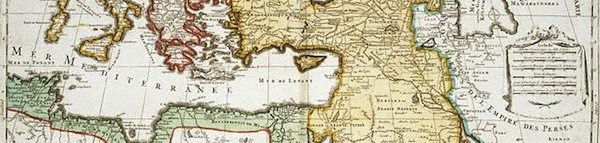
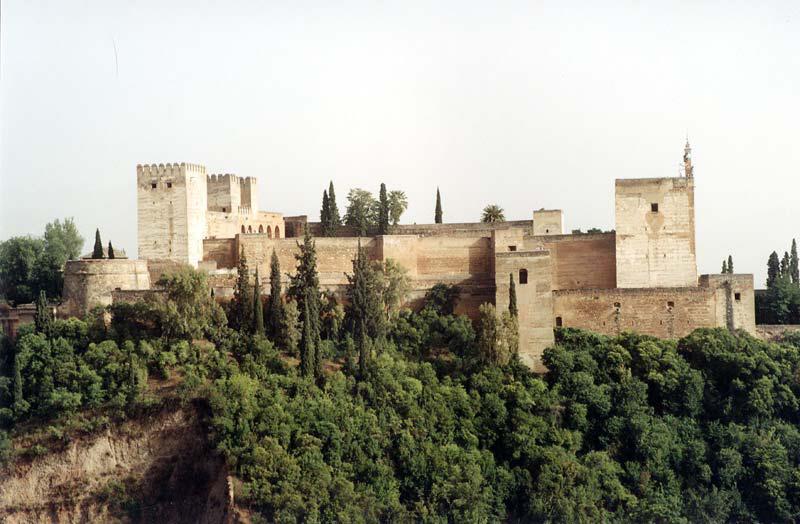
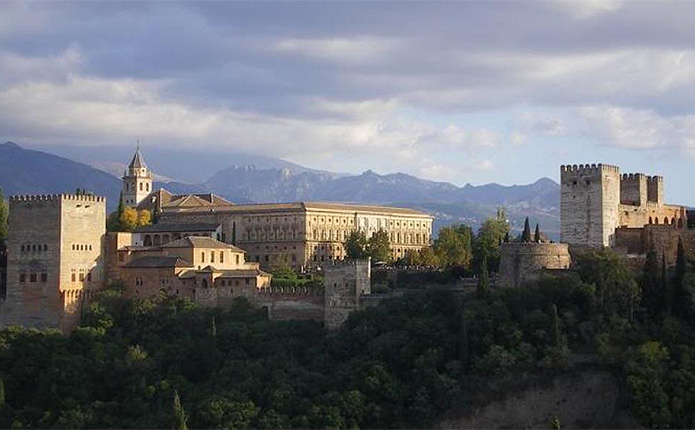
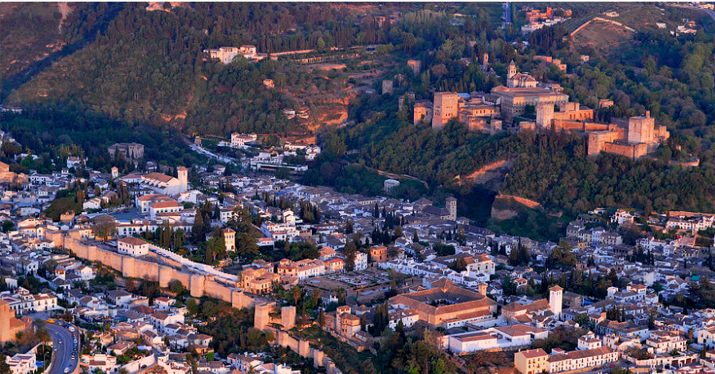
The Alhambra, meaning “the Red One” in Arabic, is a palace/fortress complex in modern day Granada, Spain. Built upon a large hill and designed foremost as a defensive structure, the facility was gradually expanded into an ornate palace complex which served as the seat of power for the Nasrid dynasty, the rulers of the kingdom of Granada. In addition to housing the sultan and his family, the specialized palaces of the complex hosted diplomats, artists, and scholars. From the time of its construction in 1248 until the day it was taken by Ferdinand and Isabella of Argon-Castille in 1492, the Alhambra was one of the most celebrated centers of culture and knowledge in the Islamic World. Such was the artistry of the architecture, that Abu Abd Allah Muhammad XII, the last emir of the Nasrid dynasty, could not bear to let it come under fire when the Catholic monarchs came to conquer Granada. The emir personally surrendered the complex before any violent conflict could damage it, and the Christian rulers moved in without delay.
The surrender of the Alhambra marked the end of the Nasrid dynasty, the last vestige of al-Andalus, Muslim-controlled Iberia. The complex had entered construction only 10 years after Sultan Muhammad Abu al-Ahmar founded the kingdom of Granada the Nasrid dynasty, and it outlived both; the story of the Alhambra parallels the history of al-Andalusi Muslims, even including their treatment after the Reconquista. The Alhambra endured centuries of upheaval and neglect, crumbling and fading under the watch of its Christian owners, just as the Muslims in Iberia were displaced and diminished under Christian rule. Only in the past several centuries has this monument to the storied history of al-Andalus received international attention, and much has been done to restore it to its former glory. Though the Muslims of al-Andalus have for centuries been victimized by the efforts of Christian Europeans to erase their complex history and minimize their accomplishments, the Alhambra stands today as a splendid reminder of both.
To better understand the Alhambra’s design, we must understand the intentions of those who commissioned its construction. As the Alhambra and the kingdom of Granada are inextricably linked, this is accomplished best by tracing the history of the kingdom’s Nasrid rulers. Muhammad Abu al-Ahmar, also called Muhammad I, was the first of the Nasrid line. He built the kingdom of Granada using territory acquired from several taifas (small, independent Muslim kingdoms) by means both militaristic and diplomatic; these taifas included Arjona, Jaen, Guadix, Baza, Almeria, Malaga, and Granada itself. When Ferdinand II of Aragon threatened to attack Granada, Muhammad I halted the king’s advance by discreetly riding out to meet the him in the midst of a siege, personally offering himself as a vassal in exchange for peace and autonomy. Under the terms of this agreement, Muhammad I would be allowed to keep the territories he had recently acquired, all of which he consolidated into the kingdom of Granada in the year 1238. Though his efforts to maintain the safety of his people earned him immense popularity, Muhammad I’s vassalage to Aragon obligated him to provide soldiers in support of the Christian reconquest of Muslim-controlled Seville in 1248, and the weight of this act pressed heavily upon his soul. In shame, he spoke the words wa la ghalib illa Allah, “there is no conqueror but God,” which would become a motto for his dynasty.
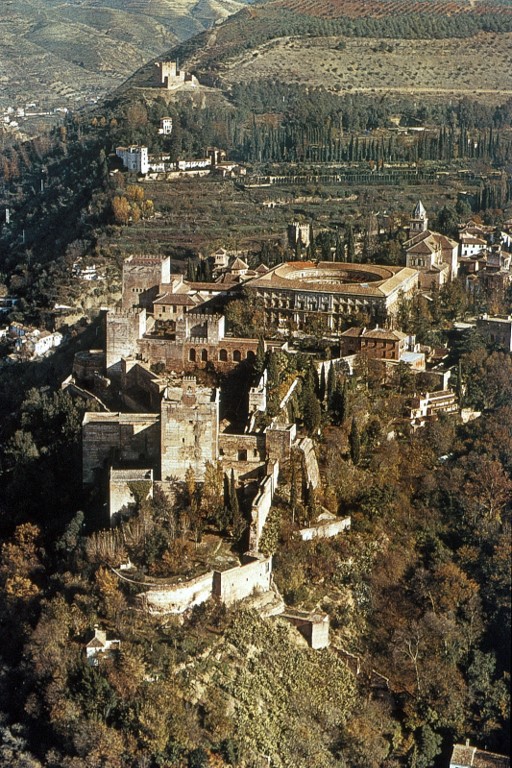
The emir knew that the peace he had brokered and sacrificed much for would not last forever, so he set about constructing a fortress of impressive scale overlooking the city of Granada. The citadel was constructed upon the Sabika Hill, atop the remains of an earlier fortress from the 9th Century. Muhammad I would not live to see its completion, which came about in 1354 under the supervision of his grandson, Yusuf. Around that time, the site was expanded into an elaborate and well-fortified palace complex, intended to serve as the center of the Granadan government. The Nasrids entered into their twilight hours in the year 1682, when an untimely scandal concerning the Sultan’s harem divided the population, followed shortly by an invasion from the recently unified Aragon-Castile. Lacking public support and hopelessly outgunned, the final emir of the Nasrid dynasty, Muhammad XII, surrendered the kingdom and the Alhambra to Ferdinand and Isabella in 1492.
The complex itself is essentially a small city on a hill overlooking the city of Granada, and is composed of several distinct parts: the Alcazaba, the Nasrid Palaces, and the Generalife. Except for the Generalife, the whole of the complex is surrounded by a moated wall which obstructs all view of the interior from below. This wall is outfitted with 22 towers placed to ensure full surveillance of the fortifications, and has four main points of entry: the Gate of Justice, the Gate of Arms, the Gate of Arrabal, and the Gate of the Seven Floors. Of these, only the Gate of Arms serves as an access point between the complex and the city below, found at the end of a winding and steeply sloped path which was designed as such for the purpose of security, inhibiting movement to slow prospective invaders.
The Alcazaba is the military component of the complex, as well as the oldest surviving component. Enclosed by a triangular configuration of walls and connected via several courtyards to the Nasrid Palaces, the Alcazaba contains the barracks and stables used to house the Sultan’s guard and horses.
The Nasrid Palaces, most notable among which are the Palace of the Comares and the Palace of the Lions, were designed to facilitate the duties of the ruler and his functionaries, impress the Sultan’s power and prosperity upon foreign diplomats, and provide the elite with a place of luxury and privacy. The Palace of the Comares was intended to service the more practical functions of government, including contact between the Sultan and his subjects or foreign ambassadors. The former would usually take place in the Golden Room, a courthouse in which a Granadan subject would meet with the Sultan, at times veiled by a curtain and often accompanied by his chamberlain, the Hajib. Meetings between the Sultan and foreign diplomats would usually take place in the Hall of Ambassadors, built in the Comares Tower and accessed via the Court of the Myrtles, ornately inscribed and decorated.
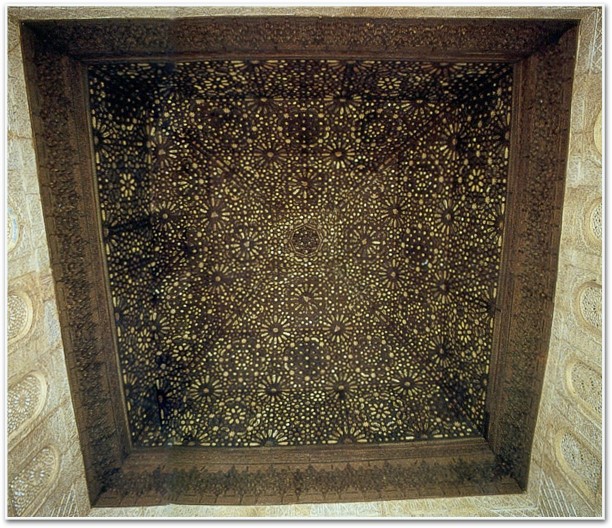
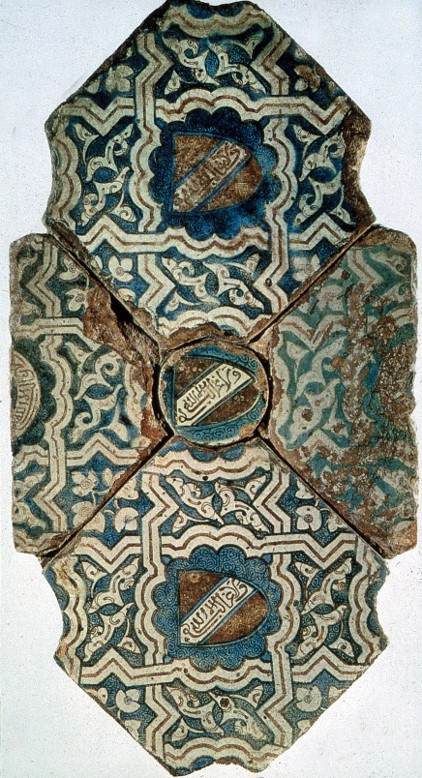
The Sultan would be seated in the exact center of the room, constructed along two axes going North-South and East-West, and two ingenious measures were employed in the room’s architecture to demonstrate his status. The first came in the form of an intricate wooden ceiling, patterned to represent the heavens, with the culminating point being positioned directly above the Sultan’s throne, conveying his place directly under God as his mortal envoy. The second came in the form of tiles on the floor in a specific configuration which were inscribed with Muhammad I’s famous words, “there is no conqueror but God;” as one could not tread atop the name of God, visitors were obligated to move aside into positions where they were off axis, creating a subtle but precisely engineered disparity with the Sultan, who was given a favorable central position.
Under King Charles V, grandson of Ferdinand and Isabella, several rooms were added and Christian/Spanish iconography was introduced between 1528 and 1533, including depictions of the Virgin and Christ as well as the Crown of Aragon and Castile. Constructed in between the Comares Palace and the Palace of the Lions, encompassing portions of both, the palace of Charles V was ordered to be built on a higher point than the Nasrid palaces and furnished with renaissance-style columns and arches, intended as a symbol of victory and superiority over the Muslim rulers of the previous era.
Today, the Alhambra is Granada’s most popular tourist attraction, and thanks to the attention it has attracted globally, the complex has been renovated to a standard approximating that of its heyday.
Sources
Alibhai, Ali. “Timeline: Nasrid {1232-1492}.” Archnet, March, 2016. https://www.archnet.org/collections/2367
Gratien, Chirs; Bishara, Fahad; Miller, Jeannie; & Ballan, Mohamad. “Legacies of al-Andalus,” Ottoman History Podcast, 2021. https://www.ottomanhistorypodcast.com/2020/11/andalus.html
Hoye, Paul. “The Alhambra.” Saudi ARAMCO World, June, 1967. https://archive.aramcoworld.com/issue/196703/the.alhambra.htm
Necipoglu, Gulru and Roxburgh, David. “The Alhambra.” Lesson 13/22 presentation developed for the Aga Khan Trust for Culture Education Programme, 2019.
Zaimeche, Salah. “Granada: The Last Refuge of Muslims in Spain,” Muslim Heritage, December 20, 2004, https://muslimheritage.com/granada-last-refuge-muslims-spain/.

