

Sarah Pardieck
In the Western world, the word harem evokes clandestine images of scantily-clad women in dim, smoky rooms preyed upon by malicious men in powerful positions. So too, is the Imperial Harem thought of as an erotic space filled with women for the sexual enjoyment of the sultan (Peirce 1993, 3). Although this notion has been reinforced by popular culture and prevailing attitudes towards Islam, it is malformed and minimizes the Imperial Harem’s true impact on Ottoman society.
Why was the Imperial Harem Important?
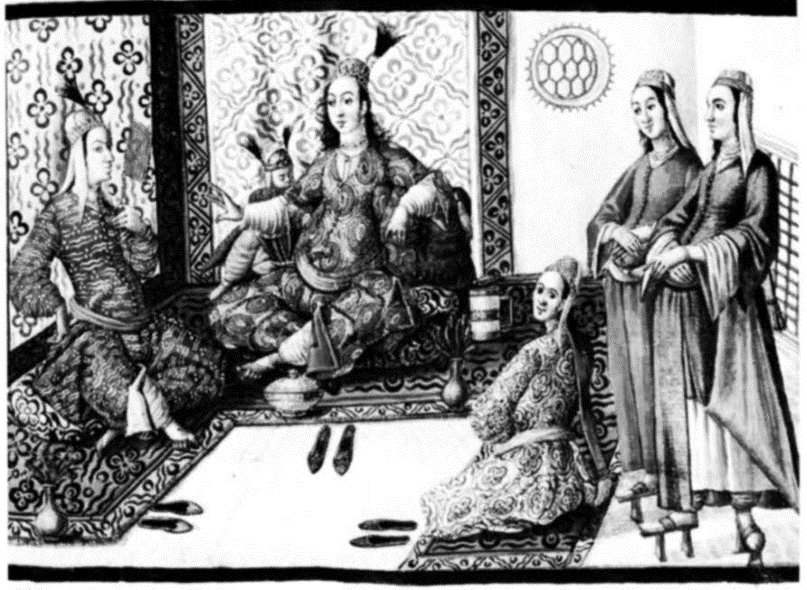
The Imperial Harem was constructed as a means to maintain the patrilineal line and serve the sultan’s needs, unknowingly it also provided the queen mothers with higher levels of autonomy within a patriarchal society. Queen mothers, valide sultans, utilized the Imperial Harem as a bargaining tool with the patriarchy. Through this institution, queen mothers achieved social ascension, and highly influenced both Ottoman politics and foreign relations.
The Institution’s Origins
The conquest of Constantinople in 1453 marked a turning point in Ottoman politics; they had finally created a centralized empire, reducing the importance of foreign marital alliances. (Kancal-Ferrari 2020, 1). Before taking Constantinople, Ottoman sultans would marry foreign princesses for political reasons, gaining allyships with families from places like Anatolia and the Balkans. This was a strategy for safe expansion, and it helped the Ottomans increase their reach. After the conquest, the Ottomans gave the Harem a much larger role in government and pursued far fewer political marriages, as they were no longer necessary. In 1459, Sultan Mehmed II constructed the New Palace, Topkapı, and through the construction of the Imperial Harem as part of the Central Court of Pages, created the right conditions to elevate women’s role in society (Necipoglu 1992, 161).
Harem girls were recruited from all stretches of the Ottoman Empire. Chosen for their beauty, the slaves were converted to Islam and underwent a strict learning regimen including instruction on reading, writing, religion, etiquette, domestic chores, and even music, dancing, singing, and storytelling. This instruction already gave the girls more skills than most during that time, which was a privilege that was not lost on them. It imparted the abilities they needed to eventually gain power in the empire. While the majority of the girls were servants or attendants, a select few became the sultan’s consorts or married other statements or ministers (Necipoglu 1992, 161). These girls were the ones who pushed their gender forward. Their seemingly demoralizing duties gave them opportunities and knowledge many could only dream of.
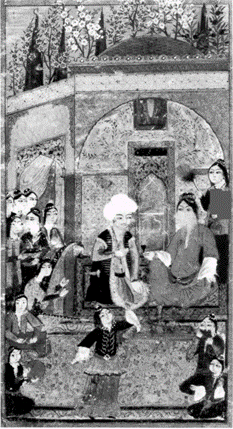
Library, Op. 7084, fol. 101v. (Necipoglu 1992, 160).
Architectural Layout
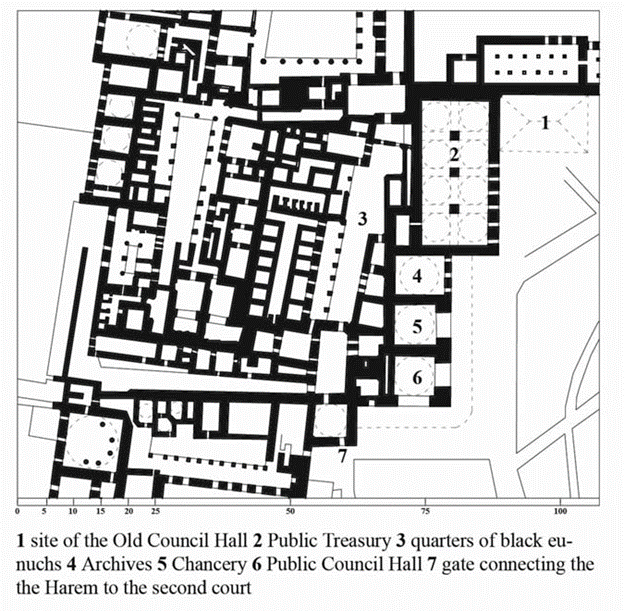
The palace was isolated from the outside world, enclosed behind a high wall called the Sur-ı Sultanî. Access to the palace was minimal, so historians lacked a thorough understanding of its inner workings (Necipoglu 1992, 159). Through maps and floor plans, we know the Harem is located in the innermost courtyard of the Topkapı Palace (Ergin 2014, 93). The palace’s walls encompass buildings, gardens, pavilions, and three courtyards. The three sections are the Birun (outer), Enderun (inner), and the Harem. Each courtyard served a specific purpose. The outermost was accessible to the public, while the second courtyard housed the main buildings of the government, and the third contained the sultan’s residence, the Chamber of Petitions, the Palace School for Pages, and the Imperial Harem (Kurban 2017, 1-7). The harem had several outlets that led to gardens for recreational purposes. When the women of the Harem participated in these halvets (“seclusions” or “retirements”) to the garden, all pages and gardeners were expelled. During that time, the concubines participated in enjoyments such as swimming and dancing in the courtyards. Solely the sultan and black eunuchs acted as intermediaries between the Harem and outside spaces; otherwise, they maintained a strict separation of the sexes (Necipoglu 1992, 183).
The Harem’s significance is demonstrated by its relationship with the sultan. Not only is it located in the palace’s central courtyard, but the sultan also spent considerable time there. The sultan’s favorite women would join him in a secluded pavilion shielded from view. Playfully, the concubines would remove their escorts’ turbans, push them into the water, or walk on their stomachs as part of their amusement and the sultan’s entertainment (Necipoglu 1992, 182). But in truth, sexual gratification was not the goal of the Harem, its purpose is to produce an heir to maintain dynastic power (Ergin 2014, 92). The main concern of the Ottomans was the welfare of the empire and an abundance of heirs was a crucial part of securing that welfare (Peirce 1993, 17). The Harem served as a training center for female slaves to increase eligibility for marriage with members of the Ottoman elite. Through these relationships, slaves could ascend the social ladder, with the ultimate goal of becoming the mother of a royal member. If a woman’s son became sultan, she too would enjoy an increase in social capital by becoming queen mother (valide sultan). Only those with children might become the queen mother. But loyalty to the sultan, despite a failure to produce an heir, still ensured a marriage to high elites (Peirce 1993, 181). In this way, the Harem was utilized to consolidate power and create loyal subjects bonded through shared beginnings, but at the same time offered the Harem’s women a larger share of that power.
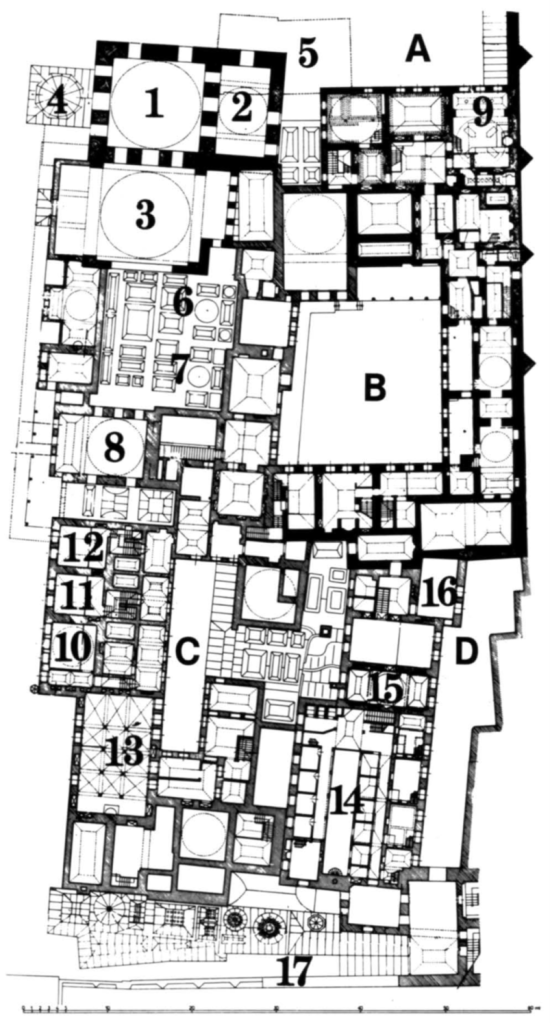
Eldem and Akozan, Topkapı.
KEY: A. marble court overlooking a pool; B. court of the Queen Mother; C. court of concubines; D. court of the
black eunuchs; 1. Murad III’s bedroom pavilion; 2. vestibule of Murad III’s bedroom pavilion; 3. Imperial Hall
(Hünkâr Sofası); 4. Ahmed I’s pavilion; 5. twin pavilions; 6. sultan’s bath; 7. Queen Mother’s bath; 8. Queen
Mother’s throne hall; 9. quarters of the princes; 10. quarters of the first haseki; 11,12. quarters of the second and
third hasekis; 13. dormitory of girls; 14. dormitory of black eunuchs; 15. school of princes; 16. quarters of the chief
black eunuch; 17. ramp descending to the outer garden (Necipoglu 1992, 168).
Imperial Harem Actors
Mehmed II’s New Palace may have housed the women, but once impregnated, the concubines were transferred to the Old Palace where the sultan’s family resided. The newborn prince would be raised in the Old Palace, then set out, accompanied by his mother, to govern a province. In 1583, Sultan Murad III (r. 1574-1595) increased the role of the Harem by moving his family’s residence and toppling the previous boundary between domestic and political spheres. Out of the Old Palace, and into the new, so to speak. New quarters were built in Topkapı for Queen Mother Nurbanu and the sultan’s numerous consorts (Necipoglu 1992, 164). Under this new palatial organization, the sultan leveraged the women’s quarters as a place of escape, inadvertently imparting power to the women themselves. Once a slave girl had sex with the sultan, she was granted attendants, her own chamber, increased pay, kitchen maids, and a eunuch. Impregnation promised greater rewards including increased income, personal attendants, and housing. Those who bore the sultan’s heir reaped the most rewards. The woman would be crowned and housed in a larger private apartment. This was quite the upgrade from the old system of transferring her to the Old Palace (Necipoglu 1992, 164).
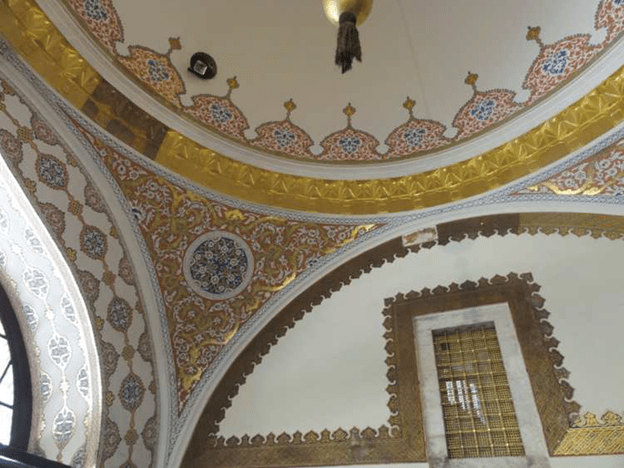
Inadvertently, the new Harem was built next to the council hall, giving easy access to it for the royal women. This gave another opportunity for women to gain influence; they used an entrance above the sultan’s royal window to gain access to hall meetings (Ergin 2014, 96). Additionally, at the end of the sixteenth century, instead of being sent to govern provinces as part of their education, princes were required to take residence in the women’s quarters. The policy enabled the women to have great influence over the princes and gave them the authority to dispose of unfit rulers (Necipoglu 1992, 174). A mother was expected to act as her son’s confidant and enhance his probability of becoming sultan. As an advocate for the prince, the mother sought to win the loyalty of the ruling class which consisted of Janissary officers and leading government officials. A mother was held responsible for the prince’s transgressions and attempted to correct the behavior (Peirce 1993, 48). Mothers of princes were motivated not only by the promise of power, becoming the next valide sultan, but the consequences of failure. The prince could suffer the brutal custom of fratricide and his mother would be exiled. This was just one more factor driving these women to rise through the ranks.
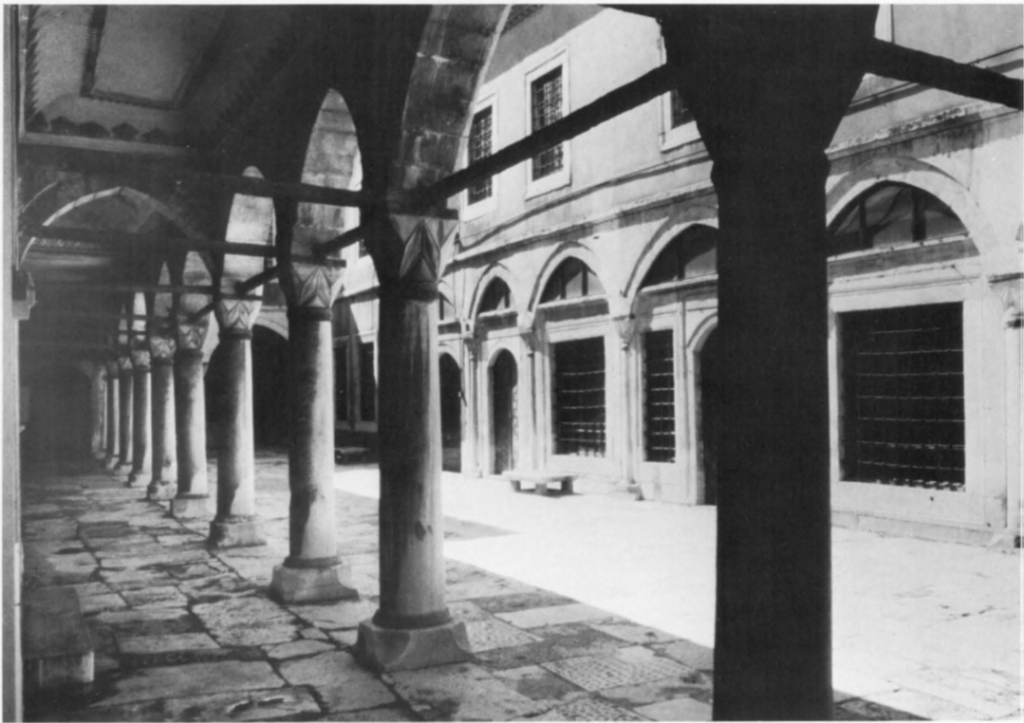
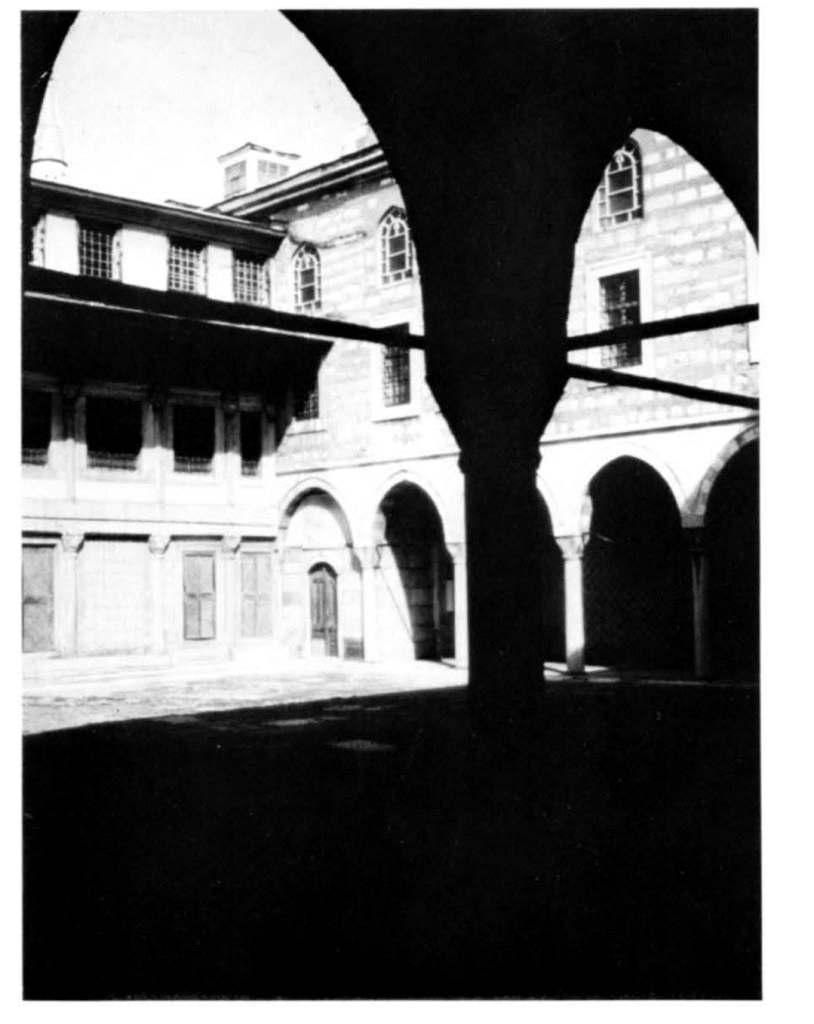
As a way to showcase their influence, many royal women commissioned impressive public buildings and lived in equally impressive abodes. The queen mother was second in command and her elaborate quarters matched her status, with her suite consisting of a bedroom, throne room, and bath. She also had the largest court of the Harem, encompassing a bakery, commissary, and kitchens. European powers interested in gaining the sultan’s favor even made tributes to the queen mother. The sultan’s first wife, referred to as baş haseki or baş kadin, followed the queen mother in the social hierarchy of the Harem. Hers is the only apartment that shared similar architectural features to the queen mother’s living quarters (Necipoglu 1992, 178). The sultan’s next two favorite concubines occupied separate apartments in the Court of Concubines. Both apartments were large rooms fitted with fireplaces overlooking the gardens with antechambers containing small toilets. The rest of the Court of Concubines housed the hasekis and young slave girls, providing them essential services such as a kitchen, commissary, laundry, ablution fountain, bath, and latrine. All these services gave the women more time to focus on their studies and allowed them the opportunity to increase their political acumen, with dreams of becoming the queen mother (Necipoglu 1992, 164).
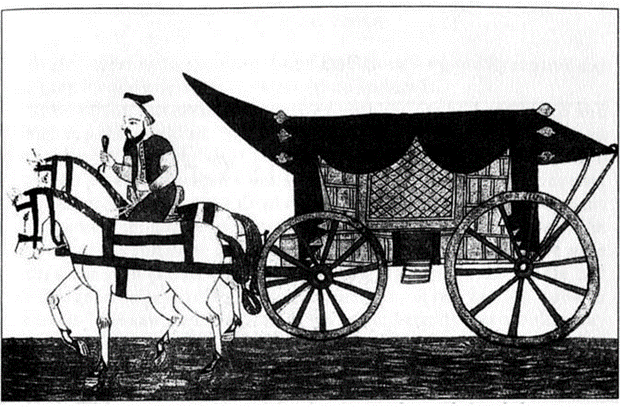
Hof- und Volksleben : Ein türkisches Miniaturenalbum aus dem 17. Jahrhundert (Hannover:
Lafaire, 1925) (Ergin 2014, 99).
As a result of uniting the empire, the Ottomans increased their dependence on the Harem and transformed it into a pseudo-preparatory school for women. By commingling with the elites, the women gained prestige, wealth, and power. From their proximity to political institutions, they learned the ways of governance and guided the empire through their sons and husbands. By any means necessary, whether concealed entrances, furtive eavesdropping, or conniving intermediaries, they had a firm hand in guiding the empire. Eventually, the facade was dropped, and the queen mother was the veritable face of the Ottomans. She managed relationships with foreign leaders, helped form policies to secure the power of her family and the prosperity of her people, and exerted her will on the world. Once lowly concubines relegated to the Old Palace, considered by many as playthings of the upper class, these women used their wit to become equals, share in the power of the land, and rule with impunity.
Bibliography
Peirce, Leslie. 1993. The Imperial Harem: Women and Sovereignty in the Ottoman Empire. New York: Oxford University Press, 1993. https://ia803205.us.archive.org/32/items/the-imperial-harem-women-and-sovereignty-in-the-ottoman-empire-1993-pdf/The-imperial-harem-Women-and-sovereignty-in-the-Ottoman-Empire-1993-pdf.pdf
Necipoglu, Gulru. 1992. Chapter Five “The Third Court: Layout of the Sultan’s Residence and the Chamber of Petitions.” In Architecture, Ceremonial, and Power the Topkapi Palace in the Fifteenth and Sixteenth Centuries, 91-110, MIT Press, 1992. https://direct.mit.edu/books/book/5086/Architecture-Ceremonial-and-PowerThe-Topkapi
Necipoglu, Gulru. Chapter Eight “The Third Court: The Imperial Harem.” In Architecture, Ceremonial, and Power The Topkapi Palace in the Fifteenth and Sixteenth Centuries , 159-183, MIT Press, 1992. https://direct.mit.edu/books/book/5086/Architecture-Ceremonial-and-PowerThe-Topkapi
Kurban, Samed. 2017. “Topkapi Palace as a Moral and Political Institutional Structure in the Ottoman Palace Organization.” International Journal of Humanities and Social Science Vol. 7, No. 3. March 2017. https://www.ijhssnet.com/journals/Vol_7_No_3_March_2017/12.pdf
Ergin, Nina. 2014. “Ottoman Royal Women’s Spaces: The Acoustic Dimension.” Journal of Women’s History 26, no. 1. Spring 2014: 89-111, 222. https://doi.org/10.1353/jowh.2014.0003 . Kançal-Ferrari, Nicole. 2020. “Topkapı Palace.” In The Great History of Istanbul from Antiquity to the XXIth Century , 1-9. İstanbul: İstanbul Büyüksehir Belediyesi Kültür A.S., 2020. https://avesis.marmara.edu.tr/yayin/a428e83f-caa0-4862-9cba-2f1e3ff7b952/topkapi-palace

