By: Mal Cianfrani
Introduction
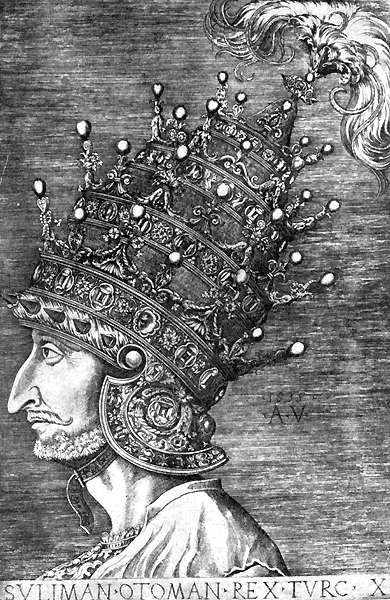
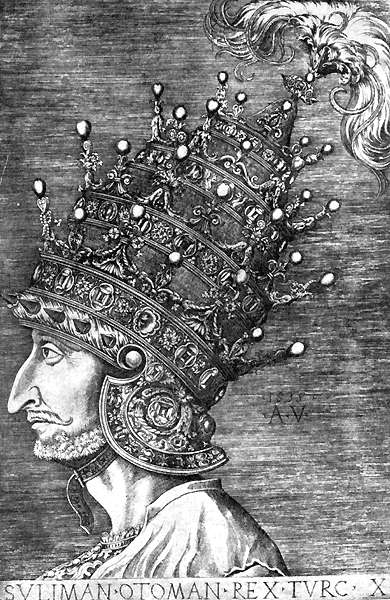
Sultan Suleyman I, who reigned from 1520-1566, commissioned the creation of an elaborate crown from Venetian artisans. This crown is a prime example of the intentional hybridity that the Ottoman Empire participated in, specifically during Suleyman’s reign. The Sultan was a known patron of Western artisans during his early reign and understood that in order to have as much power as possible, he needed to culturally appeal to all of his subjects. The crown was created to emulate the papal crown of the Pope encorporating distinctly Islamic attributes to purposefully meld Suleyman’s origins with the Catholic dynasty he was at odds with at the time. This emulation allowed for Suleyman to demonstrate his imperial power to Venetians and the Habspurg Dynasty in a nuanced and culturally relevant way.
Sultan Suleyman I’s intent to create a meaningful statement on the power of the Ottoman Empire was a success. During his reign, and long after, the papal crown became closely associated with his power due the significance it had with during it’s debut.
The Commissioning of the Crown
While the crown was acquired in 1532 for the Sultan, the person that initiated the transaction was Ibrahim Pasha, who worked as the grand vizier of Suleyman I. Ibrahim was a known collector of all things expensive and extremely experienced in ordering large pieces like Suleyman’s papal crown. Along with being a connoisseur of gold and gems, Ibrahim was Venetian born and had many contacts within Venice, where the crown was commissioned. Commissioning a papal crown from Venetian merchants was possibly an intentional act, due to the roots of the papal crown being Catholic and the purpose of the crown being to show Suleyman I’s imperial authority over the competing Habspurg Dynasty within Venice.
The men that made the crown were part of the Caorlini family of goldsmiths in Venice partnered with a variety of local jewel merchants. The brothers had previously worked on other pieces for the Sultan, including a cushion for his horse. Two of the brothers assisted in the delivery of the crown to the Sultan’s palace, arriving with the piece to deliver it directly to Ibrahim Pasha so that the Sultan could receive the gift.
The Crown
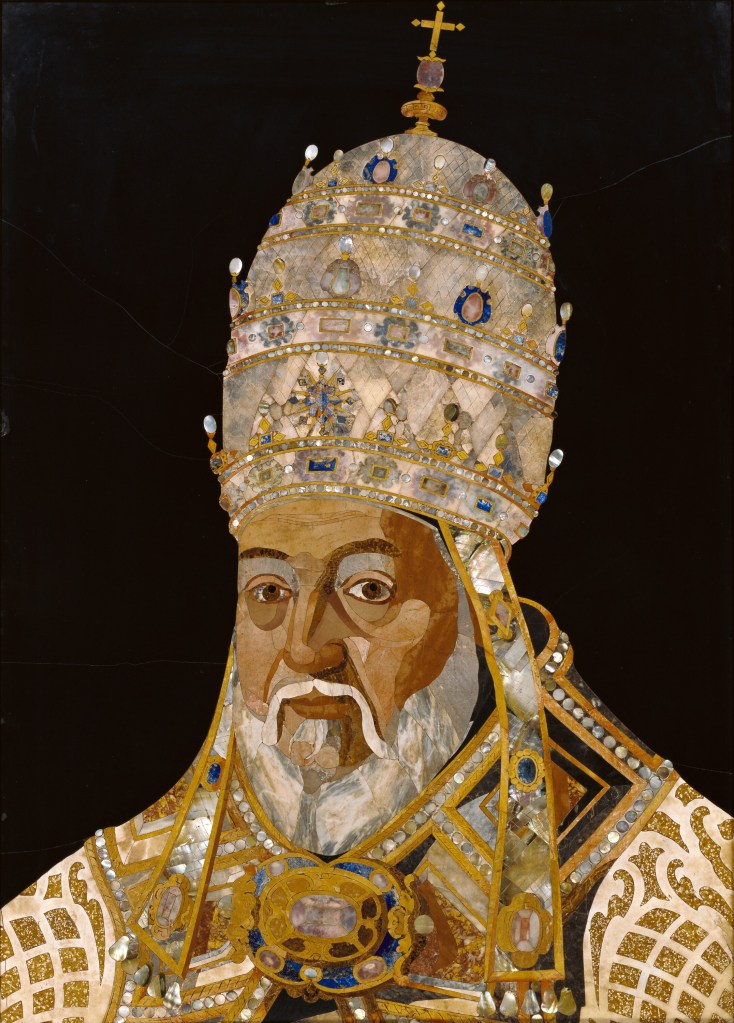
The papal crown was made of gold and had “…four crowns with enormous twelve-carat pearls, a headband with pointed diamonds, and a neck guard with straps. Featuring fifty diamonds, forty-seven rubies, twenty-seven emeralds, forty-nine pearls, and a large turquoise…including…its velvet lined gilt ebony case”, all of which came to a total of 144,400 ducats. The crown was so expensive that the acting treasurer of the time claimed that the crown was paid off in installments for several months. It is theorized that some of the gems on the crown could have come from Ibrahim Pasha’s personal collection, as a gift to his friend and Sultan.
The crown was created to emulate the papal crown of the Catholic pope, which were made out of the same materials and had three tiaras on the top and crosses adorned along the tips. On Suleyman’s papal crown, however, the crosses were swapped for the sultanic imagery of a crescent and had four tiers instead of three. The swapping of symbols was an intentional reference to the crown of the pope, and the addition of a tier possibly symbolized the Ottoman superiority over their rival.
Not only was the crown intended to emulate the papal crown, King Suleyman’s papal crown debut greatly resembled the recent coronation of his direct rival for imperial power, Charles V as Holy Roman Emperor. Both of these processions included ceremonial helmets. Charles V intentionally created a plumed helmet similar to the one that Alexander the Great wore, and Suleyman’s Venetian helmet was also adorned with a plume in a similar fashion. Sultan Suleyman’s addition of the plume was an intentional likeness to both his rival and his rolemodel, allowing for the sultan to draw on both cultural associations of power for his own nuanced statement.
The Fate of the Crown
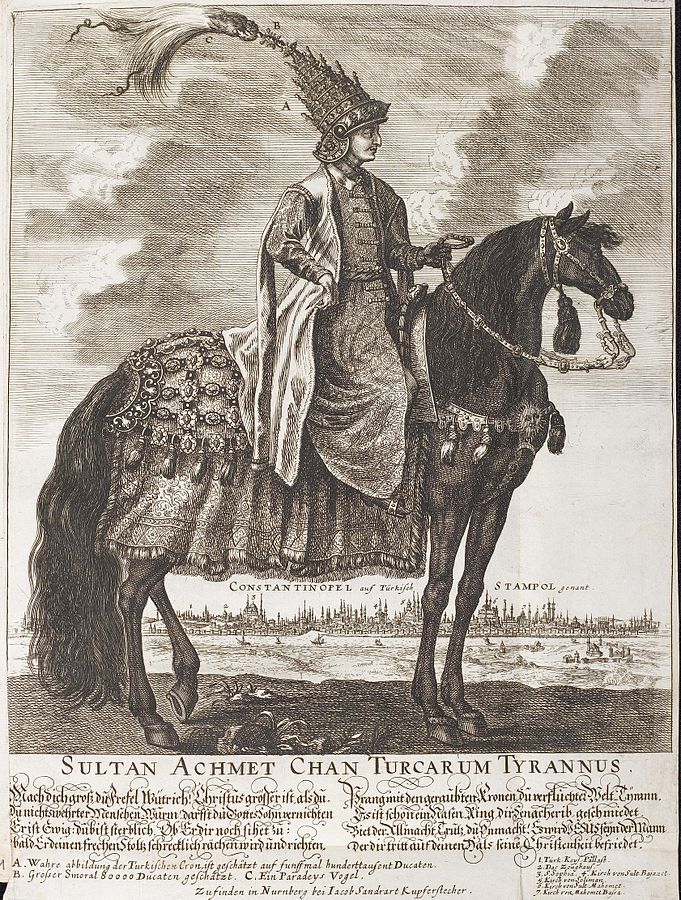
Due to the fact that Sultans did not historically wear crowns, the use of the papal crown was strictly ceremonial. The use of the crown was specifically intended to make a statement against the Habsburg Dynasty, and fell out of use once the Sultan was done making this statement. This caused the crown to carry little actual meaning within Ottoman contexts.
Near the end of Suleyman I’s reign he not only restricted his luxurious spending, but ceased participation within European status symbols, and instead canonized a classical Ottoman style of artistry. This, unfortunately, meant that the crown also came to represent the the lavish part of the sultan’s life style that he was attempting to rectify.
The fate of the crown is unknown, but it’s possible that the four tiaras atop the crown were melted down in order to be recycled and the remaining helmet was given to the Holy Roman Emperor, Ferdinand I as a gesture of good will during the Ottoman-Habsburg truce signed in 1547. This theory comes from the fact that a similar crown was documented in contemporary woodcuts, though it lacked the tiaras on the top.
If the crown was given to the Holy Roman Emperor, after being a deliberate statement of Suleyman I’s superiority over the Habsburg Dynasty, the implications of giving it away as a gift to that exact dynasty has a larger, nuanced set of implications. Sultan Suleyman, who was no longer focusing on hybridizing the Ottoman Empire and was instead creating a distinct Ottoman art style and identity in his old age, gave away the symbol of intentional cultural influence and superiority directly to his old rivals.
The symbolism involved with the papal crown begins from the very conception of it and persisists until it’s possible deconstruction and likely destination into Holy Roman hands.
Citations
- Necipoglu, Gülru. FROM BYZANTINE CONSTANTINOPLE to OTTOMAN KOSTANTINIYYE: CREATION of a COSMOPOLITAN CAPITAL and VISUAL CULTURE UNDER SULTAN MEHMED II. 2010, https://scholar.harvard.edu/files/gnecipoglu/files/necipoglu_g._from_byzantion_constantinople_to_ottoman_kostantiniyye.pdf
- Necipoglu, Gülru. FROM BYZANTINE CONSTANTINOPLE to OTTOMAN KOSTANTINIYYE: CREATION of a COSMOPOLITAN CAPITAL and VISUAL CULTURE UNDER SULTAN MEHMED II. 2010, https://scholar.harvard.edu/files/gnecipoglu/files/necipoglu_g._from_byzantion_constantinople_to_ottoman_kostantiniyye.pdf
- PULIDO-RULL, ANA. “A PRONOUNCEMENT OF ALLIANCE: AN ANONYMOUS ILLUMINATED VENETIAN MANUSCRIPT FOR SULTAN SÜLEYMAN”, Muqarnas Online 29, 1 (2012): 101-150, doi: https://doi.org/10.1163/22118993-90000185
 Objects of the Ottoman Empire