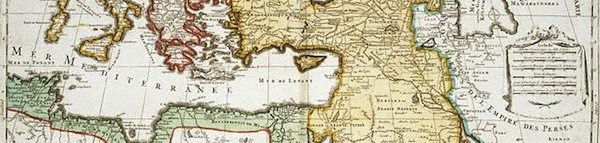
By Emma Bourne

Crafted in silver with intricate embellishments encrusting it, a pen case with an attached inkwell may seem unassuming, but its legacy remains to be a huge part of Ottoman history. Found in Turkey, this pen case is dated from the Ottoman Empire, circa 1909-1918 (1). Calligraphy in the Islamic world has always been affiliated with Islamic practices, which continues to be acknowledged in the Ottoman Empire. The Ottomans also utilized calligraphy in secular practices, including its usage in the Ottoman courts.
The origins of Ottoman prominence in the art of calligraphy can be traced back to the Beylik period in the thirteenth and fourteenth centuries, marking the beginning of the newly independent Ottoman principalities. In the City of Baghdad, the center of Abbasid power, the renowned calligrapher, Yakutu’l-Musta’simi, crafted and regularized the six basic styles of calligraphic forms. These forms were Sulus, Nesih, Muhakkak, Reyhani, Tevki, and Rika. While the Ottoman state was still in its infancy, Yakutu’l-Musta’sim’s pupils further spread his style and influence. Another prominent figure who impacted Ottoman calligraphy’s rise in influence was Seyh Hamdullah, who practiced calligraphy in Anatolia. When he became a governor of Amasya, he befriended the Sultan Mehmed the Conqueror, who later made him a master calligrapher at the Ottoman palace.(2) Calligraphy continued to evolve as the Ottomans began to rise in influence
The practice of calligraphy was a very serious endeavor, which was filled with learning and perfecting the art form. Learning calligraphy was a long process, and there were exact rules that needed to be followed for the proper execution of the art. For example, calligraphic students had to sit in a very particular manner, holding the paper with their left hand and resting on the left knee to achieve the perfect rounded letters with a train. In the Ottoman empire, children would start to learn and practice calligraphy at their elementary schools, to see if they had a talent for the craft. Master calligraphers were given a salary to teach students at a school or endowed institutions. The Ottomans adhered to a master-and-student practice of learning calligraphy as well, where master calligraphers gave private lessons in their homes.(3) This tradition is still practiced today, which illuminates how influential the Ottomans were in establishing a persistent system of calligraphic practices that are still followed.
The type of pen used was also a very important aspect of writing calligraphy for the Ottomans. Artisans focused more attention on calligraphic tools than other trades in the Ottoman Empire, due to the reverence surrounding the practice of calligraphy. Calligraphers would collect reeds from swamps and marshes, then “season” them buy burying the reeds in horse manure for about four years until they have hardened. When the reed is seasoned, the end of the reeds were cut into an angle, which had to be done frequently in order to maintain precise lines.(4) These pens would also be kept in a case with an inkwell at the end, called a divit. The cylindrical or rectangular cases were called kalemdanler, which was often lavishly decorated, much like the pen case mentioned above.(5) The tedious creation and care of these pens alludes to the importance of calligraphy in the Ottoman Empire.
A particular production of Ottoman calligraphy can be found in architectural designs. Calligraphy was used to decorate panels on civil architectural constructions, as well as religious buildings. There is an intrinsic relationship between Islam and calligraphy, so many calligraphers would draw their craft based on the architecture’s design of the mosques. They would use the Celi style of inscriptions, which are distorted lettering to account for the height to which it would be displayed on the curved ceilings of mosques. These calligraphers were called Nakkas, who specialized in decoration. They were also responsible for the incorporation of gold leaf into the lines of calligraphy.(6) The Ottomans developed a unique style of calligraphy that incorporated the legacy of past masters, along with incorporating modern techniques that displayed the splendor of the Ottoman Empire.
Calligraphic practice reached its zenith of influence during the Ottoman Empire. The Ottoman empire was a powerhouse of culture and design, as it was how they displayed imperial influence. Over a period of 500 years, the Ottomans have practiced calligraphy, in several different ways. Before the printing press, Ottoman calligraphers would make copies of the Qur’an by hand. A large number of calligraphers earned a living from copying the Qur’an (7). Using the Nesih style of writing, it gradually evolved into easy readability over the course of four centuries (8). The codification and organization of calligraphic scripts during the Ottoman empire illuminates how the art of calligraphy maintained a prominent foothold in Ottoman society for centuries because of its ability to adapt to changing social and cultural conditions.
The Ottoman court participated in “image making” in attempts to create a unified identity. By the conquest of Constantinople in the late fifteenth century, and territorial expansion in the early sixteenth century, there was an overwhelming need to develop a homogenous identity among the population of newly conquered lands. Professor Emine Fetvaci explains, “…the Ottoman elite experimented with different ways to define social and political order, and their place within it. These experiments also resulted in the developments of identifiable visual and verbal styles, which seem to give an awareness of the singularity of the Ottoman experience.” (9) The way that the Ottomans incorporated this was in regards to art and literature patronized by the sultan.
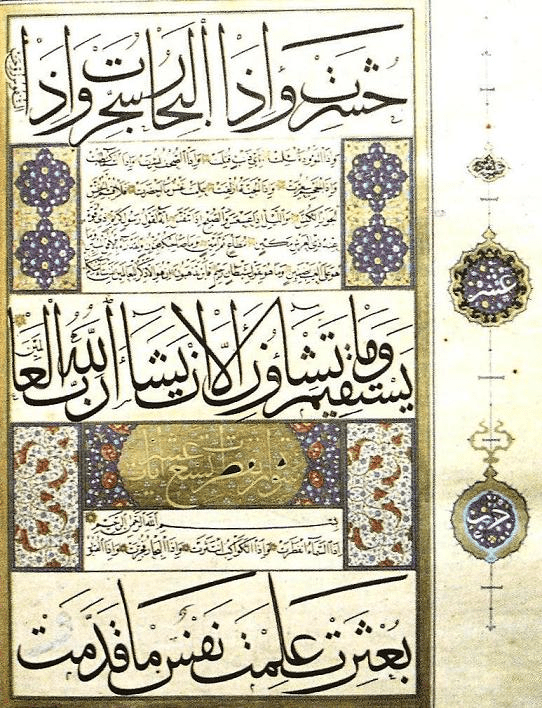
One example of this is the patronage of manuscripts, which were illustrated histories that were crafted to exemplify the lawful rule of the sultan. They incorporate paintings that illustrate the daily lives of imperial court members, and calligraphic texts that correlate with them. These manuscripts were compositions of artists and calligraphers’ work who were commissioned by elite members of Ottoman society to both enhance and justify the sultan’s rule, while also creating a uniquely unified Ottoman narrative. Fetvaci states that this was to “…present a demonstration of wealth, culture, and worthiness as a servant to the sultan” (10). These manuscripts are significant, as they document the changing interpretations of the sultan through the illustrated histories that were commissioned by the imperial court. For example, in the sixteenth century during the reign of Murad III, an influx of people involved in political discourse due to his withdrawal from the public eye. This caused conflicts between the household and the bureaucracy. Emine Fetvaci writes, “The emerging picture of unease at the face of social change also affected manuscript patronage. The higher number of people involved in court politics coincided with a boom in the production of illustrated manuscripts and a growing number of patrons for them.”(11) This means that social unease caused people to need a unifying Ottoman symbol, which resulted in the growing call for the calligraphic and artistic renderings in manuscripts.
Ottoman calligraphy is still a prominent reminder of the influence the empire had on the art form. The master-and-student system of learning calligraphy continued to produce new calligraphers throughout the existence of the empire into modern day. The Center of Islamic History, Art and Culture (IRCICA) in Istanbul, created in the nineteenth century, is still around today, further emphasizing the impact of Ottoman calligraphy. The organization also has hosted an international calligraphy competition since 1986, where calligraphers from Islamic nations and the United states have competed (12). The relevance of Ottoman Calligraphic styles reflects the continuous legacy and inspiration derived from the Ottoman empire. The Continuation of styles by prominent Ottoman calligraphers show how influential the Ottoman empire was in establishing themselves as a unique imperial entity, while continuing the religious connotations of the art form.
Bibliography:
Derman, M. Ugur. Letters in Gold, Ottoman Calligraphy from the Sakip Sabanci Collection, Istanbul. New York, NY: The Metropolitan Museum of Art, 1998.
Fetvaci, Emine, and Emine Fetvaci. “Introduction.” Essay. In Picturing History at the Ottoman Court, edited by Erdem Çipa, 1–23. Bloomington, IN: Indiana University Press, 2013.
“Pen Case with Attached Inkwell.” Smithsonian’s National Museum of Asian Art. National Museum of Asian Art, November 5, 2022. https://asia.si.edu/object/S2015.13/.
Notes:
1. Smithsonian National Museum of Asian Art, Pen Case with Attached Inkwell
2. Derman, M. Ugur, Letters in Gold, 46
3. Derman, M. Ugur, Letters in Gold, 40
4. Derman M. Ugur, Letters in Gold, 7
5. Derman M. Ugur, Letters in Gold, 8
6. Derman, M. Ugur, Letters in Gold, 33
7. Derman, M. Ugur, Letters in Gold, 33
8. Derman, M. Ugur, Letters in Gold, 33
9. Emine Fetvaci, Picturing History at the Ottoman Court, 8.
10. Fetvaci, Emine, Picturing History at the Ottoman Court, 4
11. Fetvaci, Emine, Picturing History at the Ottoman Court, 4
12. Derman M. Ugur, The Art of Calligraphy in the Ottoman Empire, 5
13. Derman, M. Ugur, Letters in Gold, 44
 Objects of the Ottoman Empire