By: Aidan Young
After moving the seat of the Eastern Roman Empire, now called the Byzantine Empire, to Constantinople in 330 A.D. Emperor Constantius set out to construct a representation of the power he held. He decided to build a church on a site next to the imperial palace for that purpose. The architecture was that of a traditional Roman basilica but on a larger scale. This church was known as the Church of Constantius II and a bishop inaugurated it in 360 A.D. The Byzantines claimed that this was one of the world’s most outstanding monuments at the time. During a series of riots in 404 A.D. the church was sadly burned down with nothing remaining. Emperor Theodosius II ordered another church to be built on the same site which became inaugurated in 415 A.D. This church lasted a bit longer than the first but burned down during the Nika Revolts during the rule of Emperor Justinian in 532. At this point the Byzantine Empire had become the primary power in the Mediterranean and so Justinian set out to construct a church on the same site to represent that power he held. Justinian commissioned a series of mathematicians and architects in order to construct the unique dome that is still famous to this day. The Emperor employed more than 10,000 workers and materials were brought from all over the empire. The church was inaugurated 5 years after construction begun in December 537 by Justinian himself. The mosaics within the church were later completed during the reign of Emperor Justin II. These mosaics featured Christian dominance over local pagan practices and represented the “triumph of Christianity over paganism.” The building also gave legitimacy to the fairly new Byzantine Empire as building a monument that impressive showed that they could be a worthy continuation of Rome. As time went on, the Hagia Sophia went on to become one of the most coveted and admired buildings in the world.
Before the Ottomans settled down and started to build their own buildings they adopted previous structures for their own use. This can best be seen in the early Ottoman practices when they first settled in Anatolia. They adopted the regional Greek style of administration upon settling and their population was mostly mixed. The Ottomans also had good relations with the Byzantine Empire, when they first settled they created strong diplomatic ties. As a result much of the land they would gain control of would be the result of integration rather than conquer. This hybridity would go on to lay the ground work for their eventual Byzantine-Ottoman imperial image the Ottomans created. The adoption of pre-existing buildings for Ottoman purposes represents another early Ottoman practice that helped form this imperial image. The Ottomans took churches and administrative buildings that they received from new lands and re-purposed them for their own use. This can be seen through their use of Byzantine columns, capitals and bricks. The Ottomans would add distinct features that labeled them as a mosque such as a crescent replacing the cross on the front and a mihrab. This reminded viewers that while the mosque may look like a Byzantine church the Ottomans had subverted that and replaced it with their own mosque. The purpose of that was to further Ottoman control over the lands they acquired and to not agitate the locals by completely changing their town. It was also much easier to adopt local structures than build your own, especially for a previously nomadic culture like the Ottomans.
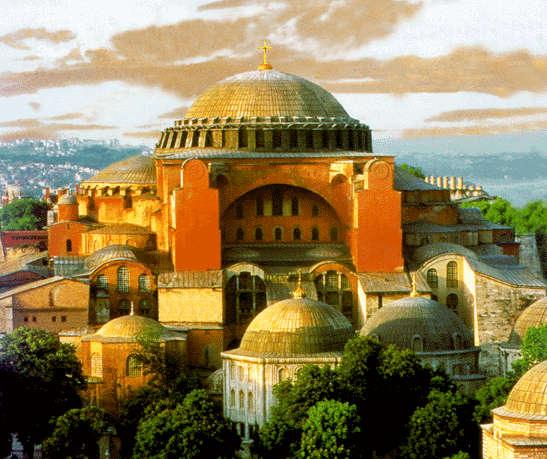
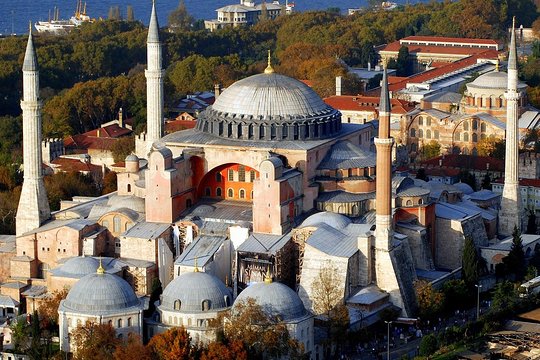
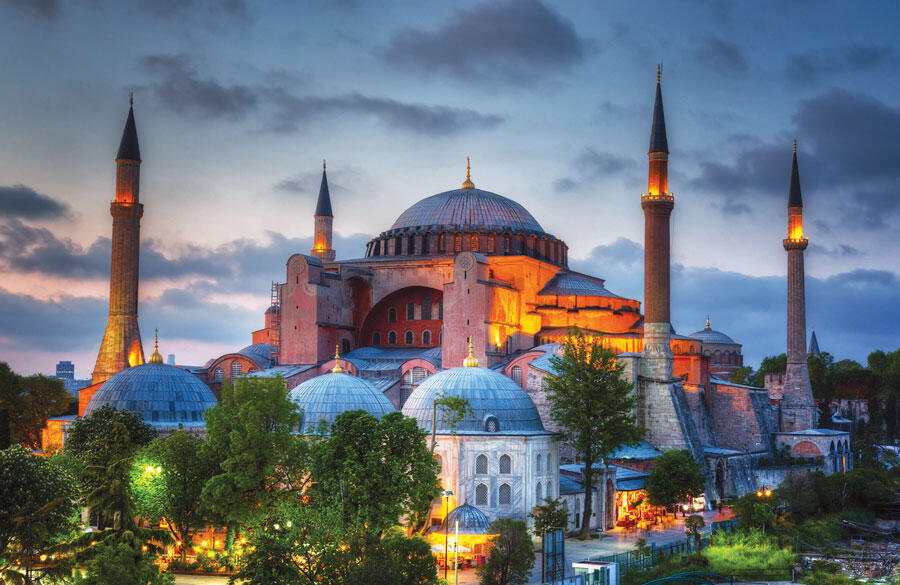
The Hagia Sophia stood under Byzantine control for almost another thousand years until the fall of Constantinople to the Ottomans. Upon taking control of the city, Mehmet set out to attempt to combine traditional Byzantine aspects of the city with distinct Ottoman characteristics to create a hybrid Ottoman-Byzantine imperial image. In doing this, Mehmet tried to invoke the power of the Byzantines and remind viewers that the Ottomans were the inheritors of that power. He had just defeated the greatest empire in the world and he wanted that to be shown through key architectural additions to the city and the church itself. Mehmet achieved this goal by adding a mihrab and two minarets. The two minarets were especially significant since they were easily visible and told viewers that the Hagia Sophia had shifted from representing Christian dominance to represent the new Ottoman dominance. The picture above this paragraph is the original design of the Hagia Sophia commissioned by Justinian and the picture at the top of the page is the modern Hagia Sophia. The extra two minarets were added almost a century later in 1574 by Selim II who saw an opportunity to further adopt the Hagia Sophia into Ottoman lore. As you can see, these minarets make a surprisingly large difference in how the building is portrayed. They are impossible for a viewer to ignore and reminds those who see it of their new Ottoman rulers. Selim also added a mausoleum to the Hagia Sophia where all past and future sultans would be interred. This furthered the legitimacy that the Hagia Sophia provided the Ottomans as the mausoleum added an Ottoman dynastic lineage that was just forming during this time. Interring the dead sultans into the church strengthened that lineage and gave it further legitimacy. While the Ottomans influenced the image of the Hagia Sophia a great deal, the Hagia Sophia also heavily influenced the Ottoman imperial image. This can best be seen through the works of the great architect Sinan. His mosques incorporate the distinctive dome shape while trying to create something new. Through invoking the Hagia Sophia in these new Ottoman buildings, Sinan was deepening the Hagia Sophia’s place in Ottoman lore. By incorporating the Hagia Sophia into the Ottoman imperial image, the Ottomans transformed what was once a representation of Christian and Byzantine domination over paganism into a display of Ottoman and Muslim domination over Christianity.
Bibliography
- Ágoston Gábor, and Bruce Alan. Masters. “Encyclopedia of the Ottoman Empire.” Encyclopedia of the Ottoman Empire, Facts on File, 2009.
- Armstrong, Gregory T. “Constantine’s Churches: Symbol and Structure.” Journal of the Society of Architectural Historians 33, no. 1 (1974): 5-16. doi:10.2307/988835.
- Necigolpu, Gulru. “The Life of an Imperial Monument: Hagia Sophia After Byzantium.” Hagia Sophia from the Age of Justinian to the Present, 1993. Cambridge University Press.
- Necigolpu, Gulru. “From Byzantine Constantinople to Ottoman Kostantiniyye: Creation of a Cosmopolitan Capital and Visual Culture Under Sultan Mehmed II.” From Byzantine to Istanbul ~ 800 years of a Capital, June 2010, pp. 262–277.
- Necipoğlu, Gülru. “Challenging the Past: Sinan and the Competitive Discourse of Early Modern Islamic Architecture.” Muqarnas, vol. 10, 1993, pp. 169–180. JSTOR, www.jstor.org/stable/1523183.
- Ousterhout, Robert. “The East, the West, and the Appropriation of the Past in Early Ottoman Architecture.” Gesta, vol. 43, no. 2, 2004, pp. 165–176. JSTOR, www.jstor.org/stable/25067103.
 Objects of the Ottoman Empire