Introduction
Textiles are an important and necessary item that we use in everyday life. In the Ottoman Empire, textile production was an industry dominated by women, so through textiles, we can learn about the life of non-elite women and their work. Islam was the majority religion in the Ottoman Empire, but textile production offered both Muslim and non-Muslim Ottoman women the opportunity to develop their autonomy by working for themselves and owning their own produce and property. Wealthy women gained were able to invest their wealth in textile shops and the ownership of expensive textile items. Elite European women and Ottoman women engaged with each other and shared textiles with each other, and these European women were able to use Ottoman textiles and fashion to express their “feminism.”
Textile Production and Property

Textiles provided important opportunities to women of all socio-economic backgrounds in Ottoman society. While previously, women generally acquired property by means of waqfs, inheritance or other family connections, in the nineteenth century it became more common for wealthy women to acquire property on their own in commercial transactions. Wealthy women were able to express their agency and acquired wealth through their ownership of textile shops, and many invested their wealth into expensive textiles such as mutarraz or ornately embroidered items
Although they had less opportunity to acquire wealthy, the nature of textile production allowed non-elite women the ability to work and support themselves. Women worked as spinners, weavers, embroiderers, and sewers within the textile industry because these were tasks that they could complete at home and on their own time, allowing them greater flexibility. Although these jobs were poorly paid, certain specializations could allow a woman greater opportunity within the sector. Women could develop their autonomy through specialization such as colorful embroidery, cloth design, and working with furs. Textile production gave non-elite women the opportunity to work, and specialization within the industry gave them even further means to empower themselves.

While both Muslim and non-Muslim women worked in textile production, Jewish women in the Ottoman empire used textiles as a means of expanding their rights. Islamic tradition held that a woman was the owner of both her property and her wage labor. Conversely, under Jewish tradition, husbands were entitled to the income of their wives. Islamicate Jurisprudential formulas found their ways into Jewish marriage contracts, and through their work in textile production, these women were able to claim ownership of their wage labor and property as well. Because textile manufacturing gave Jewish women a mode of work beyond running the household, they used Islamic law to gain property rights over what they produced, which in turn increased their agency.
Ottoman and European interactions through Textiles
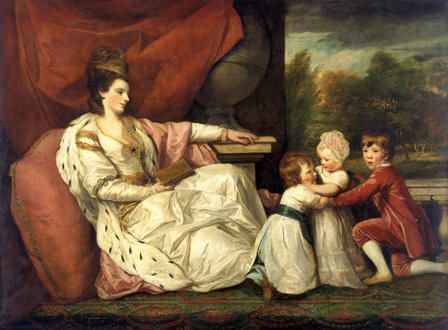
Ottoman textiles were influential in Europe as early as the reign of King Henry VIII of England who dressed as a Turkish Sultan for Costume balls. In the eighteenth-century Turquerie or Turkish Fashion became influential in France and Britain. Both elite European and elite Ottoman women engaged and traded elements of their respective textiles with one another to further express their autonomy. Wives of prominent British men used Ottoman textiles and fashion to express their “feminism.” After spending time in the Ottoman Empire, they learned about the many rights that women in the Ottoman Empire had which they in the British Empire did not have access to. These rights included the property rights discussed above, the right to refuse conjugal sex, and the right to enter contracts and divorce. Prominent British women such as Lady Mary Wortley Montagu and Elizabeth Craven dressed in the Ottoman style and in Ottoman fabrics in order to signal their interest and advocacy for the rights Ottoman women had.

European fashion held closely to rigid expectations of gender expression, with men’s and women’s dress kept in great contrast to each other, while in the Ottoman Empire both men and women wore salvar. British women then utilized this garment as a means of pushing against and threatening the gender norms they were expected to maintain. This garment even influenced American feminism, as it was the inspiration for the famous pants designed and worn by Amelia Jenks Bloomer. Elite European and Ottoman women interacted with each other through their shared interest in textiles and fashion. Both groups influenced each other, however, the influence of Ottoman textiles and fashion was especially significant in European and even American feminist efforts.
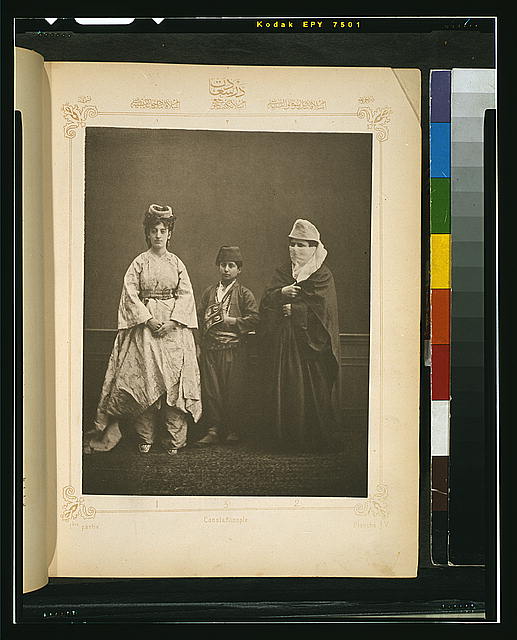
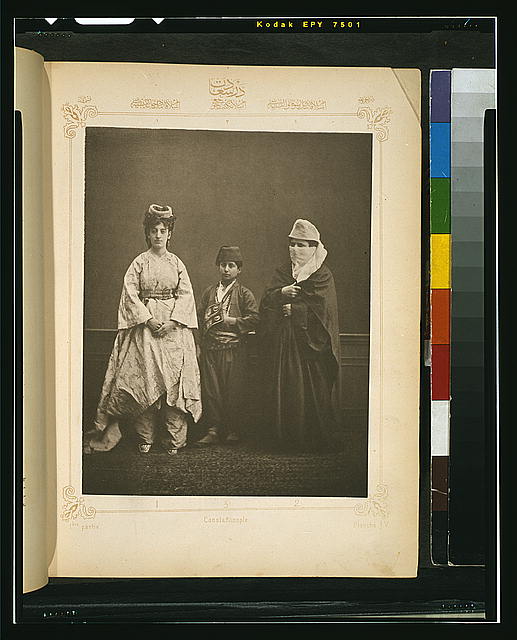
Studio portrait of models wearing traditional clothing from İstanbul, Ottoman Empire, Pascal Sebah, an example of Ottoman Salvar 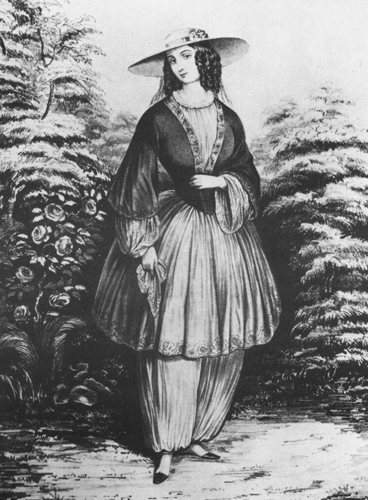
Amelia Jenks Bloomer and her Bloomers which were inspired by Ottoman Salvar
Conclusion
Textiles teach us a great deal about women’s agency and the Ottoman Empire. Through the study of textiles, we can gain a better understanding of women both inside and outside of the Ottoman Empire. Wealthy Ottoman women were able to own textile shops, and textiles were often part of their inheritances, dowries, or waqfs. Both Muslim and non-muslim Ottoman women found work in textile production which they could use to develop their agency. Jewish women in the Ottoman Empire expanded their rights by leaning into Ottoman Islamicate ideas and laws regarding property rights. Elite European and Ottoman women found a common interest in textiles and fashion. Both European and Ottoman women influenced each other, but British women specifically used Ottoman textiles and fashion to express their desire for the rights that Ottoman women already held. Through textiles, Muslim Ottoman women, non-Muslim Ottoman women, and European women who visited the Ottoman Empire engaged and interacted with one another and further developed their own opportunities and agency.
Citations
- Establet , Colette, and Jean-Paul Pascual. “Women in Damascene Families Around 1700 .” Journal of the Economic and Social History of the Orient 45 (2002): 301-319
- Hofmeester , Karen. “Jewish Ethics and Women’s Work in the Late Medieval and Early Modern Arab-Islamic World.” Internationaal Instituut Voor Sociale Geshiedenis , n.d., 1–24. 2011.
- Inal , Onur. “Women’s Fashion in Transition: Ottoman Borderlands and the Anglo-Ottoman Exchange of Costumes .” Journal of World History 22, no. 2 (2011): 243-272
- Reilly, James A. “Women in the Economic Life of Late-Ottoman Damascus .” Arabica 42 (March 1995): 79–106.
 Objects of the Ottoman Empire